The Countdown Con: How to Tell a Real Flash Sale from Pure FOMO Bait
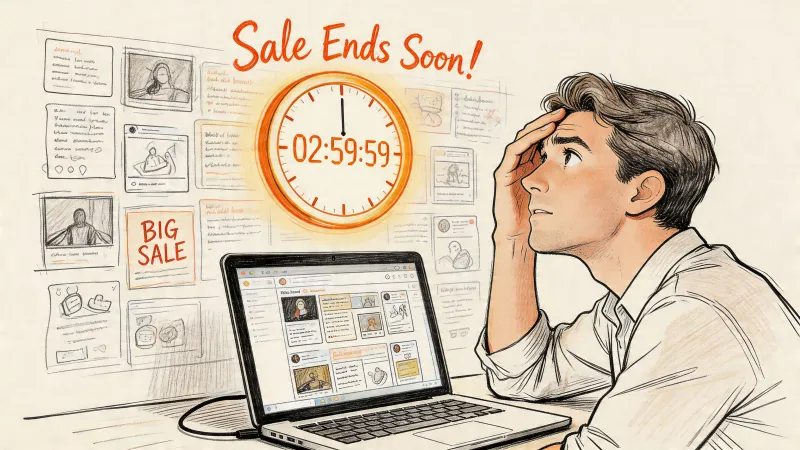
Photo: countdown timer laptop screen online sale shopping urgency, via cdnimg.co
There it is. A big red banner. A clock counting down from 02:47:13. A price slashed in half with the original crossed out in gray. Your pulse ticks up just slightly. Your finger hovers over the button.
This is not an accident.
Every element of that experience — the color, the timer, the crossed-out price, the low-stock warning — has been tested, optimized, and deployed with one specific goal: to make you buy before you think. Flash sales and limited-time offers are among the most psychologically loaded tools in the online retail playbook, and the uncomfortable truth is that they work on almost everyone, regardless of how savvy a shopper you think you are.
But here's the question that actually matters: is the deal real?
The Psychology Behind the Ticking Clock
Before we get into the numbers, it's worth understanding why urgency tactics are so effective — because once you see the mechanism, it's harder to fall for it.
Scarcity and time pressure trigger what behavioral economists call "loss aversion" — the psychological reality that humans fear losing something more than they value gaining something equivalent. When a timer counts down, your brain doesn't just see a potential discount. It sees a potential loss. You're not thinking "do I need this?" You're thinking "I'm about to miss out."
Marketers know this. They've known it for decades. Online marketplaces have simply supercharged the delivery mechanism — putting a countdown timer directly in front of millions of shoppers simultaneously, often on items they were already browsing.
The result is impulse buying at scale.
"Was" Prices: The Oldest Trick in the Book
Let's talk about the crossed-out original price — what the industry calls a "was/now" price display. You see it everywhere: $89.99 $44.99. That $45 in apparent savings feels significant. But significant compared to what, exactly?
The Federal Trade Commission has guidelines about reference pricing — the idea that the "original" price shown should reflect a price the item was actually sold at, not a fictional anchor designed to make the discount look bigger. In practice, enforcement is inconsistent, and many marketplace sellers use manufacturer's suggested retail prices (MSRPs) as their reference point — prices that almost nobody ever actually pays.
In other words, that $89.99 "original price" might be a number that exists primarily on paper. The real-world going rate for that item might have been $52 all along, which means your "flash sale" price of $44.99 is a more modest discount than advertised.
How to Actually Verify a Flash Sale Price
The good news: it takes about 90 seconds to fact-check a flash sale price, and doing so consistently will save you real money over time.
Use a price history tracker. Browser extensions that track historical pricing data are one of the most underused tools in the smart shopper's kit. Paste the product name or URL into a price history tool and you'll see a chart of what that item has actually sold for over the past several months. If the "flash sale" price is the same as the regular price — or barely different — you'll know immediately.
Search the product across multiple platforms. Open a new tab and search for the exact same item on at least two other retailers. This takes 60 seconds and immediately tells you whether the sale price is genuinely competitive or just average with a timer slapped on top.
Check completed listings and reviews for pricing clues. If a product has hundreds of reviews and has clearly been selling for a while, there's a good chance its pricing history is traceable. New listings with suspiciously high "original" prices and zero sales history are a red flag.
Which Product Categories Are Worth the Flash Sale Hype
Not all flash sales are created equal. Some product categories genuinely deliver better pricing during promotional events; others use urgency as a purely cosmetic layer over everyday prices.
Categories where flash sales can offer real value:
- Consumer electronics — Major platforms do run legitimate clearance events on last-generation tech, especially around product cycle transitions. If a newer model just launched, older inventory often gets genuinely discounted.
- Seasonal and holiday items — Post-season clearance packaged as a "flash event" is often legitimately cheap. Outdoor furniture in September, winter gear in February — the discounts are real because the inventory needs to move.
- Name-brand apparel — When established brands participate directly in platform sales events, the discounts tend to be real. Third-party resellers relabeling mediocre products as "on sale," less so.
Categories where urgency is mostly theater:
- Generic or unbranded goods — Items with no established price history are easy to inflate and discount. A $30 item marked down from a fictional $70 is just a $30 item.
- Supplements and wellness products — This category is notorious for perpetual "limited time" pricing that never actually expires.
- Phone cases, cables, and low-cost accessories — Margins are so high and competition so intense that "sale" pricing is often just the market rate with extra drama.
The FOMO Audit: A Quick Mental Check Before You Buy
Next time a countdown timer makes your finger twitch, run through this quick mental checklist:
- Would I have wanted this item yesterday, before I saw the sale? If the answer is no, urgency is doing all the work here.
- Can I verify this price against at least one other source in the next two minutes? If you're too rushed to check, that's the timer working as intended.
- Does the "original" price seem realistic? If a product is listed at a 70% discount off an MSRP you've never seen anywhere else, be skeptical.
- What happens if I wait 24 hours? Truly limited inventory does sell out. But many "flash sales" quietly reset or roll into the next promotional event. If missing this sale means the exact same item goes back to the same price tomorrow, the urgency was manufactured.
Shop Smart, Not Fast
Flash sales aren't inherently bad. Legitimate deals do exist, and there's nothing wrong with taking advantage of a genuine discount on something you actually need. The problem is when urgency replaces judgment — when the clock makes the decision instead of you.
At ShopSpot Daily, we think the best deal is always the one you made with your eyes open. Slow down, check the numbers, and let the timer run out if you need to. The real bargain hunters aren't the fastest clickers — they're the ones who know when a sale is worth their money and when it's just worth skipping.